It is now the end of the 4th week of term here in Peru and everyone has well and truly settled back into school routine.
I have still been teaching in the two schools; Indoamericano and Lizarzaburu. Things have not been running smoothly as one would hope. Peruvian schools do not function as well as they do western world schools. Teachers often arrive late to school and sometimes not at all. It is common to find classrooms without a teacher. My colleague Robert and I are finding it difficult sometimes to work with the schools as they are not co-operating as well as they should be considering we are volunteers. Even with their lack of co-operation and enthusiasm, Robert and I are still determined to teach the children as they should not suffer because of this.
As well as teaching in these two schools, I have plans to start back up football games and english classes just for the SKIP kids on Friday afternoons and maybe Saturday mornings. Something similar as to what i was doing during the summer camp. I would like to cover whatever english the kids have been learning during the week again as there is no routine of homework here in Peru.
My spanish is continually improving but not as fast as I would like, however, my friends here say to me that I am improving fast. I have started an inter-cambio which is basically a one-on-one tutoring sessions. This is free and is with a qualified spanish teacher. It is free because for the first hour she teaches me spanish and for the second hour I help her with her english. I feel I am certainly getting more out of it than her!
Volunteers are beginning to arrive. A guy from San Diego and a girl from Sydney have just arrived. The weather has took a downturn which is for the best. The days are a lot cooler but are still warm though. Being from Ireland, I have welcomed the new weather.
Well that is all for now. I posted home 3 copies of a 10 page report on my time here. It details where the money I raised has gone to and what I am doing here exactly. One copy has gone to the St. Vincente de Paul group of Maghera in Northern Ireland who kindly gave me £500. Another copy has gone to the Third World Shop in Maghera in Northern Ireland who kindly gave £1000. The final copy will stay in my home where visitors dropping by can read and find out what I am doing. It contains a lot of pictures so it should be a good read.
Apologies for there being no pictures, I still haven't repaced my camera.
As always, any potential volunteers, feel free to contact me with any queries or questions, I will be glad to help. My e-mail is m1572202@qub.ac.uk
Buena suerte
Joseph
28 March 2008

11 March 2008
School Term Begins
The school term has eventually begun here in Peru. It was suppose to begn last week but nothing ever runs on time out here. Myself and another volunteer, Robert from Manchester, are teaching in two schools.
One school is called Indoamericano where we have approximately 90 SKIP kids and the other school is called Lizarzaburu where we have only 20 Kids approximately.
Our schedule is fairly demanding. Our first class is at 7.30am until 9.00am in Lizarzaburu. We are teaching English by ourselves to the 6th grade of Primary school. Our next class is from 10.30am to 12.30pm in Indoamericano. We then support the English teachers who teach 1st grade of Secondary school in both schools. These schedules have not been finalised yet but will last until around 6.30pm.
Last week was pretty sporadic. We had arranged a lot of meetings with the schools in order to organise schedules but meetings in Peru rarely happen and even rarer on time. This is very frustrating. Anyway at the moment, we have a fairly rigid schedule and I know what I will be doing for the remainderof my time.
I was suppose to return to Ireland on April the 8th but I have changed my ticket to June the 10th. I felt 3 months was not long enough here. I would have prefered to stay until July but my ticket didnt allow me. I will stay for a total of 5 months.
Of the money I raised before coming out here, I have given SKIP £1329 so far. I have given £610 through the CAF account available on the SKIP website. This has the extra huge advantage of claiming 28% extra known as Gift Aid. The rest I have handed over as cash in Soles (S.4100 = £719) for schools uniforms, shoes and materials such as books and pens.
Lat weekend I went to a traditional Peruvian event known as a Poyada. It is a fundraising event where friends and neighbours attend and buy chicken and beer. The proceeds then go to the cause whatever it may be. This particular one was where a Peruvian girl needed money raised for her child for some reason. Didnt find out exactly.
Bit of bad news also. Got my digital camera stolen about a weel ago. I had some real good photos on it. I will just have to borrow Roberts camera. I should be able to claim the camera back on my insurance.
Here is photo of our director Bee signing the new contact with the Lizarzaburu school:

Here is my first day teaching in Lizarzaburu:
 Well that is all for now. As always, any potential volunteers want any information or have any queries, let me know and I will be glad to help. My e-mail is m1572202@qub.ac.uk
Adios
Joseph
05 March 2008
THE CHAMAN`S DEATH
 The Candoshi is one of the last indigenous tribes who conserve themselves almost intact in the middle of one of the most beautiful forests and less touched by the civilization in the planet. They are close of the Peru-Ecuador border. To arrive there, it is necessary to sail by different rivers approximately 6 days, is necessary to furrow one of the most dangerous rivers of the Peruvian forest, the Pastaza river, is necessary to cross one of the most great and beautiful lakes of Peru, the Rimachi lake, and is necessary to have, in addition to much value, some arms for protection because the Candoshi people has become one of the most violent tribes of the Peruvian forest.
 Although by the survival of the tribe they have had to fight continuous battles with near tribes and although the violence of their race it is in their genes - the Jìvaros tribe, famous for to reduce the heads of their enemies, it is come from the same sanguineous trunk - the Candoshi was pacific. The history of its last 90 years is the reason of its violence. According to official information, in the last 10 years, more than 200 "civilized" people have died or disappeared in Candoshi territory and although it exists conversations with the government on the matter, still it exists violent confrontations with "civilized" people who are found fishing, hunting or cutting trees in their territory.
When we speak about the Candoshi, like of any other indigenous tribe or old  civilization, we must remember that although they do not have the education that "civilized" people have, the antiquity of their culture and their cultural identity anyway confers an education different from ours but it is education. This without touching the most important point: that they are people like us. The few that we have had a permission of their autorities, but mainly, sufficient value to enter its territory, with the simple observation we have been able to notice that the education does not depend exclusively on wonderful advances technological or massive mass media, it is may depend of a millenarian system of moral principles - principles that we took innate each one of us and that have been, in the best one of case distorted them by our individual and collective
  circumstances. When living in the nature they are same nature, of thousand years living in comunión with the forests have taught the importance to them of the balance in the consumption of the resources, have taught to them to cause the regeneration of the consumed thing. To put an example, in the lakes that are within their territory, the Candoshi seeds and raises one of the most exotic fish and on the way to extinction of the amazonian forest, the Paiche. Its growth is so slow and difficult, and its meat so is appraised that they have rationed their fishing to an adult unit by family to the year, (an adult unit gets to measure up to 3 meters).
It is sad but more and more "civilized" people get in the nights at her lakes to fishing their Paiches (in the city it is can get to cost up to us $20 the kilogram). This is one of the reasons of their aggressiveness. They simply defend what it is belongs to them, they defend what will be the sustenance of its family.
Nevertheless, the original reason of their violence is a little older, is a little sadder, is a little more shameful.
Everything began approximately about 50 or 60 years ago, when the first missionaries (catholic, evangelical... that does not important matter) arrived at their territory. The history that has left great scars us, although with slight variations, is even repeated today and as it happened in the past the imposition of a new belief implies the eradication of the previous one and therefore the lost one of cultural identity. Like all the great mechanisms of domination, the change does not happen immediately, the work is systematic. In this case, the main axis consists of the obtaining of the confidence of the community, easy to obtain through the magical mechanisms that we have and that they never have seen. A simple electrical lamp, a mirror, a radius to battery, caramels, our way to dress, our own customs and until our language are wonderful things for them.
Unlike the past in which the salvation speech was tax through the massacre and the extermination - impossible to make in the present time due to international the public opinion (thanks to God for this) - the following step is the disrepute of the old traditions. It was that soon the medic of the Tribe, the one who through the sacred plants or the stars said to the correct time for seedtime, the fishing, for the love or the war, was represented like the representative of the devil, the same demon. Just a short time later, whenever a boy became ill, whenever a old people died, whenever the unpredictable course of the river took a cultive, was the Chaman that was sight with distrust, with rage and anger.
Soon, hated by their own brothers, by their own children, as if they was criminals, hated by people to who they cured, 8 families of chamanes with parents, children and grandsons, preferred a new life in the solitude from the forest to the pain of to see hatred in the eyes of their brothers. As if a masterful plan existed, as if everything had been calculated, the climax of the events, the fact that marked the outcome of history, it happened a day in which one of the missionaries arrived at the tribe with influenza. Just a short time later, 80% of children, old people died - they do not have defenses against ours "civilized" diseases.
One night, left to their luck by who took the death to their forests, fled with the weight in the conscience. One night in which the sadness broke the soul of the tribe, with the alcohol burning their noble hearts, the surviving men, armed with arrows, lances, stones and woods, they exterminated to the 8 families of chamanes. 8 complete families, old people and young people, wimen and man with all their things were massacreed and burned in the dark of the night and with them all the knowledge of thousand of years transmitted of generation to generation.
The tribe was lost of many years - they was confused. The missionaries who knew the truth of the things did not return. There was no the wise person who cured the snakes attacks. The time of sowing, the fishing time, the war time or the peace time, was unknown because nobody could read stars or listen to the sacred plants.
Nobody knows when they understood the mistaken, nobody knows as they discovered the truth, the pain and the confusion showed them the truth of the magical things of "civilized" people and later, as it happens in all conquest, the vultures, the plunderers those who live of the misfortune and the death arrived to take, their fish, their animals, their trees. But the Candoshi tribe, brothers of the jíbaros tribes - the hunters of human heads, brothers of the of the Achuar tribes, the soldiers of the water, they transformed their pain into fury, they painted of black colour their faces and they declared the war to the "civilized" people.
From "Travel´s Chronicles" - 2001- FGP
-------------------------------------------------------------------------------------------------
At the present time, some special children of the Candoshi tribe, are studding the knowledge of the plants and the stars with Chamans of neighboring tribes.
At the present time, although it exists pacts of peace with the Peruvian government, it is impossible to go into the Candoshi territory without a special permission of their authorities. The police in the Candoshi tribe does not exist, all law it is distributed by the political authority of the community - the Apu. The government, with the help of the international community has signed a treaty for the construction of the first small schools and first aid posts in strategic places like part of the campaign of "civilization" of indigenous communities.
The personages of this history are fiction. All similarity to the reality is pure coincidence.
Felipe.
16 February 2008
I thought i would update this blog, its been a month since i last posted anything. Things are still going great. The summer programmer is into its penultimate week. Construction has actually begun on the SKIP center so a newly developed center is on its way.
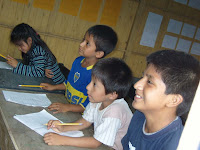
 Here are some of my students listening attentively!!
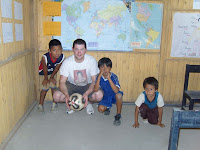
 Some of our kids outside our center in porvenir

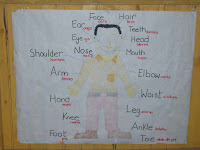
What do you think of my teaching of the human body????
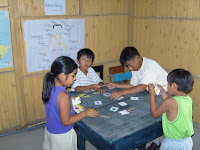
Some of my kids working hard improving their vocabulary
 Thats all for the moment.
I am still teaching english from monday to wednesday. I can actually see an improvement in some of the kids which is fantastic. They often come up to me and chat as much english to me as they can, its funny. Football still continues on Thursdays and Fridays.
The weather in trujillo is getting a lot warmer, at around 3 especially its tough.
I have started taking surfing lessons in the world famous beach near trujillo called huanchaco. Surfing is amazing and here its really cheap. SKIP volunteers get a reduced rate just for being SKIP volunteers from one particular surf shop.
I am still continuing with my free Spanish lessons. I not sure if i am improving as much I would like but its certainly enjoyable anyway. My peruvian classmates are really nice and helpful.
Cant think of much more to add. Going to add some photos also:
Here is the summer programs painting class: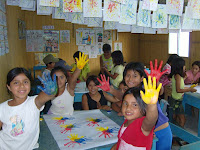
Here are the future footballers of peru (except me!!)
Here are some of my students listening attentively!! Some of our kids outside our center in porvenirWhat do you think of my teaching of the human body????
Some of my kids working hard improving their vocabulary
Thats all for the moment.Joseph
P.S. I did a lot of fundraising before I came to SKIP and managed to raise a substantial amount. If any potential volunteers needs ideas, feel free to contact me on m1572202@qub.ac.uk
22 January 2008


Here are a few photos I have managed to take. The first one is me and a few of the kids. I use the map of the world to teach "where is" to the kids. The second shows the kids working hard. On the walls is some teaching aids I put up, such as the alphabet and the numbers in English. The second shows two SKIP kids outside the center with the badge.
Joseph the Irish volunteer
Hi
My name is Joseph and Iam from Ireland. I arrived in Trujillo on Thursday 10th January to begin volunteering for SKIP. I actually began on the Monday as I spent a few days with friends in a place called Huaraz.
I have been teaching English to approximately 30 kids but not all at the one time. Its part of SKIPs summer program. On Monday and Tuesday I teach 7-10 year olds and on Wednesday 10-12 year olds. Thursday and Fridays I take about 20 boys for football in a football court beside the SKIP center in Porvenir.
I didnt know what to expect when I arrived although my friend had already volunteered and told me a lot about it already. The SKIP house where the volunteers stay is in Trujillo. The house is excellent I feel as I was expecting very basic accomodation. Porvenir is approximately a 5-10minute taxi ride from the house. Porvenir itself is very poor. The people have very little and houses are pretty dire, well thats from a western point of view.
Having said that, the people seem happy, well the kids do anyway. The kids arrive to the SKIP center smiling all the time and they greet you as if you were a celebrity, it certainly helps your self esteem!
Teaching them is amazingly rewarding because they are so keen to learn. They would often say "mas ingles" (more english) at the end of a lesson which is nice.
Trujillo itself is a nice city. It has a lovely city center and has plenty of places to eat. Next to the SKIP house is a restaurant which does delicious chicken, rice and chips!
The summer camp will be continuing for another six weeks before we the volunteers will go to the state schools to teach English. The SKIP kids get a reduced rate because a volunteer is teaching in that school I think.
I will be updating this blog regularly and if any potential volunteers have any queries, you can e-mail me at m1572202@qub.ac.uk I will be happy to help.
adios
joseph
My name is Joseph and Iam from Ireland. I arrived in Trujillo on Thursday 10th January to begin volunteering for SKIP. I actually began on the Monday as I spent a few days with friends in a place called Huaraz.
I have been teaching English to approximately 30 kids but not all at the one time. Its part of SKIPs summer program. On Monday and Tuesday I teach 7-10 year olds and on Wednesday 10-12 year olds. Thursday and Fridays I take about 20 boys for football in a football court beside the SKIP center in Porvenir.
I didnt know what to expect when I arrived although my friend had already volunteered and told me a lot about it already. The SKIP house where the volunteers stay is in Trujillo. The house is excellent I feel as I was expecting very basic accomodation. Porvenir is approximately a 5-10minute taxi ride from the house. Porvenir itself is very poor. The people have very little and houses are pretty dire, well thats from a western point of view.
Having said that, the people seem happy, well the kids do anyway. The kids arrive to the SKIP center smiling all the time and they greet you as if you were a celebrity, it certainly helps your self esteem!
Teaching them is amazingly rewarding because they are so keen to learn. They would often say "mas ingles" (more english) at the end of a lesson which is nice.
Trujillo itself is a nice city. It has a lovely city center and has plenty of places to eat. Next to the SKIP house is a restaurant which does delicious chicken, rice and chips!
The summer camp will be continuing for another six weeks before we the volunteers will go to the state schools to teach English. The SKIP kids get a reduced rate because a volunteer is teaching in that school I think.
I will be updating this blog regularly and if any potential volunteers have any queries, you can e-mail me at m1572202@qub.ac.uk I will be happy to help.
adios
joseph
18 October 2007
computer class
so some of the highlights of each week are the computer classes i get to teach to the secondary kids. we officialy got the class kicked off in march of this year and for the most part it has been a success. we havent moved all that fast in regards to covering a bunch of different programs but it has been thorough, kind of.
that last thought brings me to today. so there is two classes of computers on thursdays, one for the kids who have mornings free and the other for the kids who have afternoons free. generally speaking i have an incredibile sense of accomplisment every thursday morning when i see the kids working away on their computer home work, the most i usually have to do is remind them to not open messenger (they always are looking for former SKIP english teachers to talk with) and that they can listen to music after they have finished there work.
so the afternoon class brings about a host of other feelings, mixed feelings actually. for instance, today we were finishing up a test - generally speaking a test is something you do by yourself to TeSt your own knowledge, hence the word TeSt. i think that some of our students have an intense commitment to one anthers well being and good grades though because at some point i ceased to exist in the classroom and one of our little darlings got up and started giving pointers to two of the other kids - and all free of charge. so the mixed feeling came up in a few diferent ways.
first, how in the world did i do such a bad job of teaching that these two kids cant complete this part of the test - i am awful at this teaching gig.
second - wow, that kid is instructing two others at the same time and is doing a dang fine job at it (even though technically it was cheating) - she must have had an amazing teacher.
to satisfy the curiosity of you former Skippers, the ever so helpful student would be the freckled one that asks all the questions.
that last thought brings me to today. so there is two classes of computers on thursdays, one for the kids who have mornings free and the other for the kids who have afternoons free. generally speaking i have an incredibile sense of accomplisment every thursday morning when i see the kids working away on their computer home work, the most i usually have to do is remind them to not open messenger (they always are looking for former SKIP english teachers to talk with) and that they can listen to music after they have finished there work.
so the afternoon class brings about a host of other feelings, mixed feelings actually. for instance, today we were finishing up a test - generally speaking a test is something you do by yourself to TeSt your own knowledge, hence the word TeSt. i think that some of our students have an intense commitment to one anthers well being and good grades though because at some point i ceased to exist in the classroom and one of our little darlings got up and started giving pointers to two of the other kids - and all free of charge. so the mixed feeling came up in a few diferent ways.
first, how in the world did i do such a bad job of teaching that these two kids cant complete this part of the test - i am awful at this teaching gig.
second - wow, that kid is instructing two others at the same time and is doing a dang fine job at it (even though technically it was cheating) - she must have had an amazing teacher.
to satisfy the curiosity of you former Skippers, the ever so helpful student would be the freckled one that asks all the questions.
02 October 2007
Pictures from the Artisanal Fair


Huanchaco Beach and the volunteer dance group that performed at the artisanal fair.
Huanchaco, Huanchaco, Huanchaco!


"Huanchaco!!" bellowed the cobrador of the "H con corazon" micro as we climbed aboard the bus on Sunday. We were headed to Huanchaco beach, about 20 minutes from the SKIP house in Trujillo, to work/hang out at the artisanal fair set up by Mythri, our reigning queen of Economic Development volunteers. She had organized this fair as her ultimate project, before jetting back to the US on Monday.
SKIP had a tent set up where we sold scarves and purses knitted by the SKIP mothers in El Porvenir, along with free food- a big big hit. There was music, balloons, flyers and even a march with posters and banners advocating womens rights and feminine power. A local dance school provided a volunteer dance group who drew a large crowd with their traditional dances.
The weather even cooperated, as the sun shown breifly, but brightly.
The mothers were most excited to see their work actually being sold to strangers, for some it was their first time to Huanchaco even, and I could see the pride on their faces as scarf after scarf was picked up. Overall, we sold over 200 soles of merchandise, and gathered 50 soles in donations. More importantly, we handed out countless flyers to draw attention to SKIP and its motives.
Looking to the future, two stores in Huanchaco have now agreed to sell some the mothers' work, as the quality and technical skill has improved tremendously over the 9 months of Mythri's rule. A potential collaboration between the Huanchaco Club de Madres and the Madres de SKIP is on the horizon- the mothers would get together to teach each other new knitting techniques and other skills. SKIP has also started hosting knitting and jewellery making classes, and we hope to find stores in downtown Trujillo willing to sell some of the mothers' wares. Overall, nothing makes me smile more than to see the mothers collaborating on taking loans to buy the wool and working together on design ideas or helping each other with difficult stitches.
Laura
26 September 2007
THE AFFECTIVE WORK
One of the problems to those that faces our society at the present time, although in smaller quantity that more cosmopolitan and liberaler societies, it is the growing decrease of the affective work.
Understood the affective work as the valuable and invaluable work that implies the care, the attention and the delivery of affection to children, people of the third age and sick inside the family. Until recently, work made it and covered in more percentage for the feminine sector inside the family and the same society.
We can attribute the blame of the decrease of the affective work basically to the congenital dissatisfaction of the human species. Dissatisfaction that has led inexorably to the current reign of the materialism and the consumerism and for this way to the vertiginous career of satisfaction of a more and more growing universe of necessities. Same dissatisfaction that has made us undertake the search of ideologies with the desire of to organize and to endow of a clear horizon our more and more chaotic society. Sometimes forgetting that for the same fact of this congenitally dissatisfaction, our theories, our ideologies, more and more tendentious to the utopism, they are born condemned.
It would be unjust, however, to deny to the human species the same right to the experimentation. But we should never forget that the experimentation bears risks that in the best in the cases, our system has taken very little in our bill society.
A clear example is in fact the topic that now occupies us, almost invisible and less valuable at this time but with big repercussions to medium and long term.
We cannot make ourselves those of the fat view and to deny that the nucleus of our society, the family, it is suffering irreparable damages to the point of running the risk of a definitive separation. Fact that is clearly demonstrated mainly in the high index of divorces and the populational descent in western societies or going to the weesternization.
This is it that in fact at that the big ideological movements of political order as the socialism, the communism, the capitalism and the same feminism didn't foresee, movements born of conceptual theories that seek to contain and to homogenize an individual and heterogeneous collective where the really important differences, (as the virtues and defects), they are, completely, passed for high. Differences that are, exactly, those that grant defined the position to each individual of a society. They have endowed us of one idealized and ephemeral freedom that it has allowed to break up with certain and preset lists, unchaining a widespread chaos with disastrous consequences to medium and I release term.
Without forgetting that it was the Catholic doctrine the culprit of the centuries of darkness regarding the woman's rights, we should return the look on the shoulders and to observe to the old civilizations (as the Egyptian in east or the Catarian in occident) where the women and the femininity had a fundamental list in the society.
It would be absurd, for example, not to recognize that, so much physical as spiritually, men and women are born differentiated. It would be absurd not to recognize that each one is born with tendencies and defined lists, replaced in some cases but never completely. It is not a fotuituos thing that is the woman the one that has been blessed with the gift of the conception. It is not a fortuitous thing that has been the woman the main one not in charge of the affective work alone inside the family, but also in our same society.
It is certain that a special relationship exists between femininity and affection. Observing for one second some other animal species because after all we are, also, animals, could we hope a male fulfills the maternal function just as at would make it a female of the species?
Grateful the fundamental importance of the affective work for the subsistence of the family as the nucleus of our society and its considerable decrease, would be necessary to wonder: Are we prepared to replace a growing market of affective work?
Today, as the labor freedom for the feminine sector has grown, we face a drastic decrease of the affective work and that, what is more dangerous, this will be inside in a little time one of the biggest lacks in our society. It would be more simple if this work it could be managed with the laws that govern the current labor market. That makes of the affective work something difficult of manage - the intrinsic value that this supposes why it implies an interaction that is much more than the physical aspect. It is very difficult, due to the grade in that an affective worker is forced to be involved with the object of his care, much more if this work is carried out inside its same family, for this it is very difficult to implant a control that can settle down standard of quality, (we should realise that this quality will vary substantially if the work is carried outside of the family environment), fact that makes impossible the handling of this sector with the rules that govern to the rest of the labor market.
Another important factor is the depreciation of the affective work. It is undeniable that the works that imply the service and people's care directly, it is still in the lowest steps in the labor pyramid, so much in what refers at the salary like in what refers to social prestige.
Through the history, the importance of the affective work, it has always been observed from points of view different to the really important one. To mention an example, in the Rumania previous to the ninety, the one that was the last communist bastion in Europe, the affective work was seen as an important factor although not for the real value that implied the care and the union of the family. It existed, even, a reconciliation system for the families that wanted to get divorced, wants that, finally, it was granted them after draining in different instances, all the possibilities of a reconciliation. However, "(…) the political system was not really interested in the health and the well-being of the family. The only thing that wanted was the individual's control. A control exercised through the fear, through the mistrust, impairing the channel of the trust inside the family and the friends through the totalitarist speech of subjection to the ideological régime. Ingrained speech with such an effectiveness to each person, mainly to the youngest that it was frequent to see friends and even children denouncing co-workers, school teachers or parents for anticommunist comments. (…) This was the grade of importance of the family nucleus with it was considered for the régime that in cases of accusations for the style, without caring of where they came and without mediating trial some, "Securetatea", the intelligence system and the interior politics's armed arm that Ceausescu implanted for such an end, disarticulated the family in question of hours, sending the children to orphanages and the parents to lingering imprisonments." (I summarize of interview with Andrei Ciobutaro, outstanding artist and Romanian thinker liberate.)
It is undeniable that the capitalism also founded its pillars in the family nucleus, but mainly in the affective work made, even at the present time, by the feminine sector, on the main function, the administration of the home and the fabric of the cooperation nets and solidarity, base of the patriarchal institution. This without speaking about the main function: the reproduction of the human species, or rather, the producer of the biggest value in the capitalism, the manpower.
In our days, the affective work, (although in different scale and level that the one carried out in the family nucleus), so scarce and minimized lately, it is beyond the family environment. The globalization, the saturation of the markets, the politics of limitless consumerism and the levels of competition of the modern companies, it have forced to the search of new techniques and technologies that are able to increase the redeeming and the time of answer to markets more and more difficult of satisfying and specialized. In such a way, it is not a secret that the fixed capital, the goods properties or the machinery, it is not more the biggest for the modern companies. What is really important is the human structure, the grade in that the personnel is involved with the objectives of the company, the way in that they socialize among themselves until getting the ideal comfort in the work atmosphere that allows them to develop to the maximum his invention capacity, of search of solutions for the changes of the market "just in time" and finally the organizational and re-organizational capacity. It is in this environment where the affective work acquires an enormous and new dimension: the complicated fabric of an affective net of communication, among a heterogeneous group of individuals with the purpose of improving the productivity.
It suits, observed and grateful the undeniable importance and the necessity of the affective work, to foresee their future lack. We would not need to be geniuses or seers to glimpse a future in which the affective work is one of the most important professions and required by our society in its different levels.
We need however, first, to recognize the essential value of this work. We need to change the false conception of smaller quantity that our society have granted him. Maybe this it is the biggest obstacle that we have to conquer. For such an effect it is of vital importance, in the first place that glimpse that this goes a lot beyond the dispute between machismo and feminism. In second place that the same state, through the educational sector, it should be involved with the preventive task, through the integration to the educational curricula, of courses in those that the student, not alone it learns and recognize the importance of the affective work in our society, but rather it also teaches to the new generations, be men or women, for to be prepared to replace in this function at family level in first time.
Felipe
Understood the affective work as the valuable and invaluable work that implies the care, the attention and the delivery of affection to children, people of the third age and sick inside the family. Until recently, work made it and covered in more percentage for the feminine sector inside the family and the same society.
We can attribute the blame of the decrease of the affective work basically to the congenital dissatisfaction of the human species. Dissatisfaction that has led inexorably to the current reign of the materialism and the consumerism and for this way to the vertiginous career of satisfaction of a more and more growing universe of necessities. Same dissatisfaction that has made us undertake the search of ideologies with the desire of to organize and to endow of a clear horizon our more and more chaotic society. Sometimes forgetting that for the same fact of this congenitally dissatisfaction, our theories, our ideologies, more and more tendentious to the utopism, they are born condemned.
It would be unjust, however, to deny to the human species the same right to the experimentation. But we should never forget that the experimentation bears risks that in the best in the cases, our system has taken very little in our bill society.
A clear example is in fact the topic that now occupies us, almost invisible and less valuable at this time but with big repercussions to medium and long term.
We cannot make ourselves those of the fat view and to deny that the nucleus of our society, the family, it is suffering irreparable damages to the point of running the risk of a definitive separation. Fact that is clearly demonstrated mainly in the high index of divorces and the populational descent in western societies or going to the weesternization.
This is it that in fact at that the big ideological movements of political order as the socialism, the communism, the capitalism and the same feminism didn't foresee, movements born of conceptual theories that seek to contain and to homogenize an individual and heterogeneous collective where the really important differences, (as the virtues and defects), they are, completely, passed for high. Differences that are, exactly, those that grant defined the position to each individual of a society. They have endowed us of one idealized and ephemeral freedom that it has allowed to break up with certain and preset lists, unchaining a widespread chaos with disastrous consequences to medium and I release term.
Without forgetting that it was the Catholic doctrine the culprit of the centuries of darkness regarding the woman's rights, we should return the look on the shoulders and to observe to the old civilizations (as the Egyptian in east or the Catarian in occident) where the women and the femininity had a fundamental list in the society.
It would be absurd, for example, not to recognize that, so much physical as spiritually, men and women are born differentiated. It would be absurd not to recognize that each one is born with tendencies and defined lists, replaced in some cases but never completely. It is not a fotuituos thing that is the woman the one that has been blessed with the gift of the conception. It is not a fortuitous thing that has been the woman the main one not in charge of the affective work alone inside the family, but also in our same society.
It is certain that a special relationship exists between femininity and affection. Observing for one second some other animal species because after all we are, also, animals, could we hope a male fulfills the maternal function just as at would make it a female of the species?
Grateful the fundamental importance of the affective work for the subsistence of the family as the nucleus of our society and its considerable decrease, would be necessary to wonder: Are we prepared to replace a growing market of affective work?
Today, as the labor freedom for the feminine sector has grown, we face a drastic decrease of the affective work and that, what is more dangerous, this will be inside in a little time one of the biggest lacks in our society. It would be more simple if this work it could be managed with the laws that govern the current labor market. That makes of the affective work something difficult of manage - the intrinsic value that this supposes why it implies an interaction that is much more than the physical aspect. It is very difficult, due to the grade in that an affective worker is forced to be involved with the object of his care, much more if this work is carried out inside its same family, for this it is very difficult to implant a control that can settle down standard of quality, (we should realise that this quality will vary substantially if the work is carried outside of the family environment), fact that makes impossible the handling of this sector with the rules that govern to the rest of the labor market.
Another important factor is the depreciation of the affective work. It is undeniable that the works that imply the service and people's care directly, it is still in the lowest steps in the labor pyramid, so much in what refers at the salary like in what refers to social prestige.
Through the history, the importance of the affective work, it has always been observed from points of view different to the really important one. To mention an example, in the Rumania previous to the ninety, the one that was the last communist bastion in Europe, the affective work was seen as an important factor although not for the real value that implied the care and the union of the family. It existed, even, a reconciliation system for the families that wanted to get divorced, wants that, finally, it was granted them after draining in different instances, all the possibilities of a reconciliation. However, "(…) the political system was not really interested in the health and the well-being of the family. The only thing that wanted was the individual's control. A control exercised through the fear, through the mistrust, impairing the channel of the trust inside the family and the friends through the totalitarist speech of subjection to the ideological régime. Ingrained speech with such an effectiveness to each person, mainly to the youngest that it was frequent to see friends and even children denouncing co-workers, school teachers or parents for anticommunist comments. (…) This was the grade of importance of the family nucleus with it was considered for the régime that in cases of accusations for the style, without caring of where they came and without mediating trial some, "Securetatea", the intelligence system and the interior politics's armed arm that Ceausescu implanted for such an end, disarticulated the family in question of hours, sending the children to orphanages and the parents to lingering imprisonments." (I summarize of interview with Andrei Ciobutaro, outstanding artist and Romanian thinker liberate.)
It is undeniable that the capitalism also founded its pillars in the family nucleus, but mainly in the affective work made, even at the present time, by the feminine sector, on the main function, the administration of the home and the fabric of the cooperation nets and solidarity, base of the patriarchal institution. This without speaking about the main function: the reproduction of the human species, or rather, the producer of the biggest value in the capitalism, the manpower.
In our days, the affective work, (although in different scale and level that the one carried out in the family nucleus), so scarce and minimized lately, it is beyond the family environment. The globalization, the saturation of the markets, the politics of limitless consumerism and the levels of competition of the modern companies, it have forced to the search of new techniques and technologies that are able to increase the redeeming and the time of answer to markets more and more difficult of satisfying and specialized. In such a way, it is not a secret that the fixed capital, the goods properties or the machinery, it is not more the biggest for the modern companies. What is really important is the human structure, the grade in that the personnel is involved with the objectives of the company, the way in that they socialize among themselves until getting the ideal comfort in the work atmosphere that allows them to develop to the maximum his invention capacity, of search of solutions for the changes of the market "just in time" and finally the organizational and re-organizational capacity. It is in this environment where the affective work acquires an enormous and new dimension: the complicated fabric of an affective net of communication, among a heterogeneous group of individuals with the purpose of improving the productivity.
It suits, observed and grateful the undeniable importance and the necessity of the affective work, to foresee their future lack. We would not need to be geniuses or seers to glimpse a future in which the affective work is one of the most important professions and required by our society in its different levels.
We need however, first, to recognize the essential value of this work. We need to change the false conception of smaller quantity that our society have granted him. Maybe this it is the biggest obstacle that we have to conquer. For such an effect it is of vital importance, in the first place that glimpse that this goes a lot beyond the dispute between machismo and feminism. In second place that the same state, through the educational sector, it should be involved with the preventive task, through the integration to the educational curricula, of courses in those that the student, not alone it learns and recognize the importance of the affective work in our society, but rather it also teaches to the new generations, be men or women, for to be prepared to replace in this function at family level in first time.
Felipe
18 September 2007
ONE MORE DAY IN THE JUNGLE


The night falls and it dawns another time in the forest. The time seems detained here, beside the Ucayali river in a town a day from Iquitos. The first school that I came to build is almost finishedand we have begun a new one not far from here.
Some months have passed since I began to work here and I have not still stopped to wonder if we are right in sowing cement where before alone there were trees and animals, but that is a big and different topic from what I want to relate.
 What I want to relate is that the earth here has another color, the heat is so strong that sometimes one wonders why we are here. That the forest sometimes squashes us with its constant sample of life. That the insects are unbearable alone between the 6 and 7.30 in the night.
What i want to relate is that the children still go barefoot to the old wooden school. That they still play in the torrential rains as if these were a blessing, that an indescribable innocence exists in their eyes. That innocence that we have lost in the big cities. That trying not to get their attention - always impossible - I observe them every morning wondering to myself if some of them imagine thatother world of which we come. but the probable thing is that it does not even interest them although some of them will finish working driving a taxi for the streets of some great city.
 15 men have come with me to build this first school. 15 men that make their work very well between laughs and jokes. 15 both young and old people that have become as siblings after a time. But only 14 have returned. One of them, my friend Henrry, the nearest to me, the one that followed me in range, one that the same as to my he liked the fishing, he died while he was transported to our camp bitten by a snake. Him and four more of them went to cut the wood that we needed for the construction in a place amid the forest 8 hours from our camp. One week they had to finish their work and to return with the wood, but they returned on the third day with my friend dead.Although I have wanted a lot, I have not been able to leave the jungle to go to his funeral, neither have I met his family - he had two daughters and a woman waiting for him .
 I know that theinsurance for accidents or death of the organization with which I work will give to his family enough money so that they can live calm and that they will send us a new antidote easier for transporting and of oral administration, the previous one was via veins and given by the male nurse that travels with us. The new antidote is not as efficient as the other one but it slows the action of the poison enough time to arrive to the camp.
Some days ago in the blog of a friend I read about the necessity of the search of the truth, of the love and of oneself and remembering my first months here, i thought that it is true that we all are looking for something although some people do not even know that they are doing it. I also remembered to Henrry and I thought that we always look for ephemeral things. That the truth is what we look for things or feelings or states of spirit that the only thing that it does is to exalt our ego.
 One afternoon, talking about the poverty, after a moment of silence, my friend - a bit sad - said to me: "for me, to be poor, just can be to see die of hunger to my children" This one, was my friend's truth, this one it is an universal truth.
Felipe.
17 September 2007
Ciao Sarita
Its a bit raro how quickly people can just come and go here. Although most volunteers stay for at least a month, I have met one who stayed for under two weeks, and others who sign on for up to two years. Unfortunately, we just lost one of the best, our English Teacher volunteer, Sara. She has left behind a formidable legacy- just this morning she gave a presentationt to the heads of other local Peruvian NGOs about an online Directory that she worked hard to realize. This directory will help create contacts between the various organizations, so hopefully we can work juntos and have a greater impact on the community.
Sara was also an invaluable teacher at the SKIP school. Recent attendance levels have been the highest ever at SKIP English class, and the students really opened up to her and started talking, even the shyest of the shy. She helped Joshua plan the saturday classes and orchestrated an evening trip to the Teatro Municipal in downtown Trujillo to see a presentation on traditional Peruvian and Mexican dances.
Although we all understand that she needs to return home and earn some money, it will be strange not to grab a morning taxi with her to El Porvenir, or plan the next baking endeavor with her and Josh.
Ciao Sara, ya te extranamos!
Sara was also an invaluable teacher at the SKIP school. Recent attendance levels have been the highest ever at SKIP English class, and the students really opened up to her and started talking, even the shyest of the shy. She helped Joshua plan the saturday classes and orchestrated an evening trip to the Teatro Municipal in downtown Trujillo to see a presentation on traditional Peruvian and Mexican dances.
Although we all understand that she needs to return home and earn some money, it will be strange not to grab a morning taxi with her to El Porvenir, or plan the next baking endeavor with her and Josh.
Ciao Sara, ya te extranamos!
13 September 2007
Don't Throw Out Dead Dogs
There's the obvious that makes life in El Porvenir so shockingly different from what i know- the extreme poverty evident in the houses made of crumbling adobe brick, the trash heaps lining the unpaved roads, the little girls walking around in skirts and flipflops in the middle of winter while I wouldn't be able to survive without my NorthFace. But then there's the smaller, less evident things. For example, in one of the classrooms at the public school, the students were studying how to protect the environment. They had written on strips of posters (about 2 or 4 whole posters for the entire class to share, unlike back home where my Spanish teacher could pull out stacks of different colored papers and a carton of markers to draw with) advice such as "don't burn trash," "dont use persticides" etc. While there was nothing about wasting water or turning off the light when you don't use it (not things they have to worry about since most houses don't have those amenities) there were a few strips that read "don't throw dead dogs onto the street." At first I thought I had misread it, but upon consideration, I see how that can be a huge problem. Somedays I see as many dogs as little kids running around unattended. Once, we even had a dog walk right into the classroom that I was teaching in. Those kids ended up getting an extra lesson on animals that day, until I finally had to kick the poor animal out because it was becoming to much of a destraction.
In other SKIP news, Mythri, our amamzing Economic Development gal, brought four mothers to open savings accounts in a local bank- a huge first step. The bank requires 50 soles to open an account, and a minimum blalnce at all times of 10 soles (a little under $4) so we used SKIP money to help them open the accounts and then just took out whatever was not theirs. When Mythri first brought up the idea of savings accounts to the mothers at one of the Saturday charlas, many of them were intrigued by the idea. As one of the mothers explained, its very hard for them to keep moeny in their pockets, even though they have so little. What happens is that one of their kids begs and begs for a sweet so she relents, and then the 4 or 5 other kids she has come begging to, and there goes the sol or two she had saved. However, with the money in the bank, so won't be able to feel guilty and give in. So, we have high hopes that this will be a great new project and really help the mothers of El Porveir.
In other SKIP news, Mythri, our amamzing Economic Development gal, brought four mothers to open savings accounts in a local bank- a huge first step. The bank requires 50 soles to open an account, and a minimum blalnce at all times of 10 soles (a little under $4) so we used SKIP money to help them open the accounts and then just took out whatever was not theirs. When Mythri first brought up the idea of savings accounts to the mothers at one of the Saturday charlas, many of them were intrigued by the idea. As one of the mothers explained, its very hard for them to keep moeny in their pockets, even though they have so little. What happens is that one of their kids begs and begs for a sweet so she relents, and then the 4 or 5 other kids she has come begging to, and there goes the sol or two she had saved. However, with the money in the bank, so won't be able to feel guilty and give in. So, we have high hopes that this will be a great new project and really help the mothers of El Porveir.
10 September 2007
One small step for man, one giant leap for mankind
Yesterday was a day to remember for SKIP, as we finally inaugurated the new office that has been under construction for a little while now. Previously we had been working out of the building belonging to the Mother's Club of El Porvenir, with temporary walls wedged in place with plastic water bottles and offices the size of closets.
 Now, each section- education, psychology, social work and economic development has their own separate space, along with an area for overall managment. The building is located right within the SKIP school, only about 10 feet from where we were before, but it gives SKIP a vital sense of independance, identity and accomplishment.
The ceremony itself was the typical pomp-and-circumstance affair, with the local alcalde arriving about one hour late to break a bottle over the doorjamb. Although most of the mothers left as soon as all the free food was gone, overall the day was a success.
 Now, each section- education, psychology, social work and economic development has their own separate space, along with an area for overall managment. The building is located right within the SKIP school, only about 10 feet from where we were before, but it gives SKIP a vital sense of independance, identity and accomplishment.
The ceremony itself was the typical pomp-and-circumstance affair, with the local alcalde arriving about one hour late to break a bottle over the
 doorjamb. Although most of the mothers left as soon as all the free food was gone, overall the day was a success.
31 August 2007
"hello how are you i'm fine"
Hola!
My name is Laura, and I arrived in Trujillo two weeks ago to volunteer with SKIP as an English teacher for the next four months. I just graduated high school and am spending a gap year volunteering before I head to college next September.
Peru welcomed me with arms wide open- the earthquake in Ica happening on the eve of my flight out of Washington DC, and truth be told I was extremely nervous about coming. All I had planned out was a flight to Lima and then up to Trujillo, were a "Larry" was supposed to meet me. Thankfully he was there, and after dropping my stuff at the SKIP house, we hit the ground running. Larry, the director of SKIP, took me to el Porvenir, the neighborhood where the SKIP office and school is located. The Saturday "Charla" (charlar is spanish for "to speak") had just concluded and Peruvian mothers were streaming out of the school's entrance discussing what they had just learned about- each week SKIP addresses a different topic, such as earthquake safety or personal hygeine. I greeted countless faces, some of whom I've come to know pretty well over the past two weeks, with a kiss on the cheek. Kids also would randomly run up and grab your hand, then motion that they to wanted to kiss you hello, or just be held and hugged, regardless of the fact that we'd never met before.
On my first Monday I accompanied another English teacher volunteer to the nearby colegio, Indoamericana, where I would be teaching classes myself- little did I know just how soon I was to start. Wednesday found me standing alone in front of a class of 40 sixth graders chiming, in one breath "hello how are you i'm happy." I've learned since then that it is imperative to approach each class with a plan, and to stick to it, no matter how out of control or unattentive the children seem, becuase if, as a teacher, you give the impression that you know what you're doing, the class tends to go by at least a little smoother.
My name is Laura, and I arrived in Trujillo two weeks ago to volunteer with SKIP as an English teacher for the next four months. I just graduated high school and am spending a gap year volunteering before I head to college next September.
Peru welcomed me with arms wide open- the earthquake in Ica happening on the eve of my flight out of Washington DC, and truth be told I was extremely nervous about coming. All I had planned out was a flight to Lima and then up to Trujillo, were a "Larry" was supposed to meet me. Thankfully he was there, and after dropping my stuff at the SKIP house, we hit the ground running. Larry, the director of SKIP, took me to el Porvenir, the neighborhood where the SKIP office and school is located. The Saturday "Charla" (charlar is spanish for "to speak") had just concluded and Peruvian mothers were streaming out of the school's entrance discussing what they had just learned about- each week SKIP addresses a different topic, such as earthquake safety or personal hygeine. I greeted countless faces, some of whom I've come to know pretty well over the past two weeks, with a kiss on the cheek. Kids also would randomly run up and grab your hand, then motion that they to wanted to kiss you hello, or just be held and hugged, regardless of the fact that we'd never met before.
On my first Monday I accompanied another English teacher volunteer to the nearby colegio, Indoamericana, where I would be teaching classes myself- little did I know just how soon I was to start. Wednesday found me standing alone in front of a class of 40 sixth graders chiming, in one breath "hello how are you i'm happy." I've learned since then that it is imperative to approach each class with a plan, and to stick to it, no matter how out of control or unattentive the children seem, becuase if, as a teacher, you give the impression that you know what you're doing, the class tends to go by at least a little smoother.
24 July 2007
EDUCACIÓN, POLÍTICA Y CIRCUNSTANCIAS
Si pudiéramos regresar el tiempo y mirar desde la altura que nos da el tiempo transcurrido, el curso que ha seguido la historia de la educación en nuestro país, llegaríamos a la conclusión lógica y desesperanzante de que la institución educativa en nuestro Perú ha sido siempre, en gran parte, un órgano político al servicio de la ideología dominante. A esto último se debe en gran parte el caos en el sector educativo de nuestro país. Cada gobierno entrante ha instaurado una nueva política de desarrollo educativo olvidándose del anterior sistema. Cada gobernante ha planteado una maravillosa reforma educativa sin importarle el anterior camino andado. A esto último se suma la dificultad del territorio, las grandes distancias, las diferencias étnicas y socioculturales y el importante hecho de que la docencia en nuestro país esta ubicada en casi el último escalón laboral. Comparado con países de regimenes educativos sólidos, en los que la educación es impartida por dos fuentes importantes: el Estado y la familia, de alguna manera, los sectores mas bajos, que son en promedio el 80% de la población total, se han vuelto completamente dependientes del sistema. Es sobre el estado que cae la tan difícil tarea de satisfacer la necesidad educativa en los sectores en los que la familia no puede cumplir el rol educativo. Para nadie es un secreto que la educación en nuestro país cumple una función tan solo paliativa, remedial. Una revolución educativa debe ir de la mano de la depuración del sistema educativo, esto no quiere decir la eliminación de personal no capacitado, si no por el contrario, es necesario, en lugar de generar mas profesionales docentes sin suficiente preparación, es necesario una reagrupación, una reorganización del sector con la finalidad de una intensa capacitación. La idea de que cualquier profesional podría ocupar el lugar de un docente en una escuela, es de por sí una utopía, aquellos que de alguna manera hemos tenido algún acercamiento con niños sabemos lo arduo y difícil que puede resultar el intentar mantener el control sobre 15 o 20 niños. Esto sin tomar en cuenta que es necesaria una formación pedagógica y psicológica para poder luego tratar con niños. Esto último para opinar sobre aquella idea que dice que cualquiera podría ponerse al frente de un aula en caso hagan falta profesionales docentes. Lo último que necesitamos son profesionales desempleados cumpliendo de mala gana y a regañadientes la función tan importante de un educador.
La tarea de educar un país y de cambiar por este medio su futuro, no es una tarea que se puede hacer de la noche a la mañana. Pasaran todavía algunas generaciones antes que puedan verse los resultados de los cambios que se tomen en este momento. Tendremos mas huelgas y mas gente protestando en la calle por que el cambio genera siempre terror en las masas (los cambios siempre valen la pena si son los correctos). Lo importante es QUÉ estamos haciendo ahora. Lo importante es que cada vez más gente se aventura a dar una opinión, a poner un granito de arena, a ayudar en esta ardua tarea. Lo importante es empezar ahora.
Felipe Gamboa.
La tarea de educar un país y de cambiar por este medio su futuro, no es una tarea que se puede hacer de la noche a la mañana. Pasaran todavía algunas generaciones antes que puedan verse los resultados de los cambios que se tomen en este momento. Tendremos mas huelgas y mas gente protestando en la calle por que el cambio genera siempre terror en las masas (los cambios siempre valen la pena si son los correctos). Lo importante es QUÉ estamos haciendo ahora. Lo importante es que cada vez más gente se aventura a dar una opinión, a poner un granito de arena, a ayudar en esta ardua tarea. Lo importante es empezar ahora.
Felipe Gamboa.
16 July 2007
Indefinite time... and reasons
07/15/07
Posted by sara in the blog "2007 Fellow: Sara Zampierin" @ 07:14:44 pmThis blog is in response to a post on the blog, “Educational Equity, Politics & Policy in Texas.” As a part of my AP fellow position, I feel that it is important to express my views and what I have seen firsthand in working with SKIP. Hopefully, I can spread awareness of this issue beyond Peru, because education is truly a universal right that is due to these children.
From the perspective of someone currently working in Peru with an education-focused NGO, I do not think this reaction by the teachers is understandable.
In the past 15 years, teacher strikes have caused students to miss 167 days. Since the entirety of public school is 10 grade levels, this amounts to almost two-thirds of a school year missed over those 10 years.
This strike isn’t the first time the teachers have responded in a negative way to attempts to elevate the quality of teachers. For example, after it was announced last year that they would be required to take an exam, the teachers union got a hold of a copy and posted it on their website. Once a new one was created, they demanded teachers boycott the test. Four out of five teachers still took it, but half of these teachers failed the elementary-level math questions and a third failed reading comprehension.
It’s no wonder the students in Peru do so badly in comparison to other nations. In the 2000 PISA test of 15-year old students from 43 countries, Peru children had the worst average score in all three tests of reading, math, and science literacy. To put this into perspective, in mathematic literacy the United States ranked 20th out of the 43 countries. Peru’s average score was lower than the scores of 95% of the children in the US, with similar results on the other three exams. Throughout my education classes in college, I constantly lamented about the state of education in the US, especially for those students who were perpetually stuck in the lowest-performing schools. Imagine an entire country where the norm is those schools.
During this most recent strike, some of the teachers have been involved in violent protests— blocking roads and airports, fighting with police, and even killing a child who got caught in the middle of a rock-throwing fight between teachers and police. Now that the law has successfully been passed that forces teachers to pass an exam, they have changed their position in order to continue the strike. They are now demanding more government spending for education before going back to work.
It’s understandable that these teachers are worried about losing their jobs, judging by the results of the last exam. However, why not demand more teacher training or support for these exams instead of refusing to be held to any standards? It is also understandable that these teachers want more money from the government for education, and I completely agree. But it’s hard to justify that by striking they are really helping the children when these kids are kept out of the schools and not able to learn.
Anticipating a long strike, the teachers gave the children stacks of worksheets as “homework” to do during the strikes, and sent them home to somehow learn this material on their own. With parents who often did not attend school, a lack of educational resources, and a weak foundation of basic skills and education, how do they expect these children to understand new material on their own?
The children enrolled in our program have been coming to SKIP every day, some in both the morning and afternoon. When some of the older children beg me to teach them more English, or another asks for help with learning fractions (starting from what a fraction even is and going all the way through to adding, subtracting, etc), how can I say no?
Peru has solved one of the first major problems in education, in having 90% of the school-aged children enrolled in school and getting these children excited to learn. I see it every day, when our kids line up at the SKIP offices before we even get there or fight over what new vocabulary they want to learn in English. The government and the teachers both need to do their parts to make sure it is worth it for these children, and that they are getting the education they desire and deserve.
Now, the trouble is getting that message through to both groups…
Sixth grade girls Maria and Vanessa practicing their new vocabulary (and correcting each other)

06 July 2007
Advocacy and SKIP
Hola! My name is Sara, and I'm one of the new SKIP volunteers along with Jessica. We have come to SKIP through The Advocacy Project, a US-based non-profit, and our goal is to create a new advocacy campaign for SKIP. We will be posting blogs over the next few months as we describe our experiences, but we have a few to catch up with first!
Enjoy! -Jessica and Sara
SARA:
Huelga indefinida
Posted by sara in the blog "2007 Fellow: Sara Zampierin" @ 02:32:13 pm
Holidays and money... and what I can make of the Peruvian system of education
Posted by sara in the blog "2007 Fellow: Sara Zampierin" @ 03:42:32 pm
Reaching out to the community, here and abroad
Finally in Peru!
Posted by sara in the blog "2007 Fellow: Sara Zampierin" @ 04:05:19 pm
JESSICA:
First impressions
Posted by jessica in the blog "2007 Fellow: Jessica Boccardo" @ 10:15:22 pm
Posted by jessica in the blog "2007 Fellow: Jessica Boccardo" @ 02:38:42 pm
Posted by jessica in the blog "2007 Fellow: Jessica Boccardo" @ 08:12:40 pm
Primer dia en Trujillo
Posted by jessica in the blog "2007 Fellow: Jessica Boccardo" @ 20:26:37
Enjoy! -Jessica and Sara
SARA:
07/04/07
Huelga indefinida 
Posted by sara in the blog "2007 Fellow: Sara Zampierin" @ 02:32:13 pm I wouldn't normally update my blog so soon, but I find myself with unexpected free time since school was canceled for today, tomorrow, and indefinitely beyond that...
The teachers union has declared a "Huelga Indefinida", an indefinite strike to protest a law that would require all teachers to pass examinations. The current teachers who failed the basic skills test three times would also be fired. One of the union leaders was quoted as saying, "It's like telling a student that doesn't pass exams, just go home." Right, the only difference is that children depend on these teachers to teach the material on these exams, not just learn it... which would give a better explanation for students currently failing tests as well.
The subdirector at the colegio (vice principal by American school structure) told us the news this morning, and said it could be a few months or more if they could not come to an agreement with the legislature. When we remarked, "The poor students", his concern was seemed minimal, and he said maybe they would make the days up in January, during their summer break.
At the same time, in reading news articles and blogs on the topic, it seems that the teachers are trying to stop passage of this law at least partially because they want to include a larger budget for education and teacher training for every teacher. Both of these things are necessities for Peru to improve their education, and they are correct in that the government isn't doing this on their own. It seems that both sides are fighting each other, but which side really is fighting with the best interests of the children and their education in mind?
In light of the strike, we will be meeting with SKIP staff and volunteers to discuss how SKIP will react, including possible extra classes or different activities for the children. Also, we need to discuss how we will use this strike, the newest attack on education for the children of Peru, to go forward with the advocacy project.
Meanwhile, I thought I'd post a report done on SKIP by news here. Even if you don't understand Spanish, you can see some of the SKIP children, families, and volunteers in action!
07/03/07
Holidays and money... and what I can make of the Peruvian system of education
Posted by sara in the blog "2007 Fellow: Sara Zampierin" @ 03:42:32 pm The two most important new words I’ve learned in Spanish here: feriado and huelga, implying national holiday and strike, respectively. Last week, the public schools were closed 3 out of 5 days for a combination of a strike and two days feriados, a Saint holiday and extra day mandated by the president to encourage tourism.
I was able to start visiting the schools and interact with the children through teaching a few of their English classes. Besides the strikes and holidays, I’m quickly learning more about the Peruvian public education, and I can’t help but contrast it with my own experiences. For example, when a teacher doesn’t show in Peru, the whole class goes home. Of the six classes I’ve tried to teach in the past two weeks, this has happened to two of them (on top of all the days those children already weren’t going to school).
Jessica and I are starting to look more into the issues of advocating for a free, quality education for all children in Peru. It turns out that the government basically only provides enough money to pay teacher salaries. On top of paying for their school supplies and uniforms, each child must pay money to the APAFA, the parent association, which in turn is supposed to supply the money for improvements and maintenance of the school. When I watch the kids at recess kicking around pieces of trash to play soccer or using a big hole in the ground as a mini- jungle gym, I wonder what all the money is going. The APAFAs are not required to report their spending, and are seen as a large part of the corruption of the education system of Peru.
When a country only spends 3.3% of its GDP on education (Economist, link in the blog post from 5/22/07), and household contributions to education are 50% of the government’s expense per student (Saavedra, 2001), it’s no surprise that they come in towards the bottom in international testing. Add that to the problem of teachers striking or failing tests of basic primary skills, and it’s a miracle that students still even show up at all.
Meanwhile, the government wants to spend more money from it’s already inadequate budget—approximately $43,750,000 on the One Laptop Per Child Program (link is to a blog translated to English, since most of the news on this subject is in Spanish). The blog expresses some of the same concerns I have— are the parents going to continue to pay so much for the supposedly “free” education? With a teacher force that has already been so widely criticized for their lack of basic knowledge, how do they expect the students will be better equipped to learn with these laptops?
06/28/07
Reaching out to the community, here and abroad
One thing that doesn’t change from country to country — free food always attracts a crowd.
We went to a fair in Huanchaco, a beach town very close to Trujillo last week. Tables were set up for a competition and judging of seafood dishes. One of SKIP’s volunteers heard about it and thought it would be a great place to tell local people more about SKIP, so the organizer gave us special permission to set up our own table. We commissioned the mothers to make us special snacks, in order to give them the extra income rather than buying it from the stores.
As soon as we set up our table we had people coming up to us, curious about either the food or what SKIP was. We only asked for donations if people wanted to try the food, and people contributed much more than they would pay for these snacks on the street or in stores.
We had more than 5 people express serious interest in volunteering with us, and we actually made more money than we spent on the goodies. Also, it seemed that since they were donating money, everyone took more interest in really caring about what SKIP does for the kids in El Porvenir, and I think the biggest accomplishment of the day was getting our name, mission, and brochures out to so many people.

Recently, SKIP wrote a “Volunteer Mission,” describing why SKIP uses a volunteer based model. Of course, a large part of the need for volunteers is that as a small NGO, it is not practical to have a largely paid staff. But the SKIP volunteer model provides an opportunity for the kids to interact with people from all over the world, with different cultures, ideas, and perspectives on life.
The volunteers also all work together, since the job descriptions are not rigid and they are free to take on other projects that interest them or match with their previous experience. Most importantly, there is constantly a fresh perspective and creative ideas, brought by people who clearly have a large passion for this sort of work with children, families, and the community. The volunteers have the freedom to suggest new ideas like the Huanchaco Fair, new community newsletters, or new ideas for advocacy—just to name a few of the current projects.
It is exciting to be a part of a small NGO that is trying to expand its outreach and support efforts. As soon as Jessica, the other AP Fellow with SKIP, got to Trujillo, the three of us more clearly defined our advocacy project for SKIP as both helping SKIP improve it's efforts in Trujillo and in pressuring for a higher quality education for the children in Peru.
Hopefully, this advocacy project will put SKIP in contact with many other organizations with similar goals and create a new, more global project for interns. Jessica and I will start with finding organizations at a local, national, and international level that share SKIP's goal of quality education and helping underprivileged children, so if anyone has any organizations or ideas in mind, please feel free to post them!
06/23/07
Finally in Peru!
Posted by sara in the blog "2007 Fellow: Sara Zampierin" @ 04:05:19 pm After a long month of waiting to depart and a long air travel complete with lost tickets and unexpected stops, I finally arrived in Trujillo on Thursday. And moments after arriving in my new home, I sat down with Larry, the director of SKIP, and had a candid discussion about advocacy and what it means to advocate for SKIP and the children they support.
It’s not an easy topic for many reasons. There’s not even an equivalent translation in Spanish, and I’ve gotten used to explaining advocacy in Spanish with many words, at least as how we’ve defined it. Our vision for this advocacy project with SKIP involves treating quality education as a right for all of these children. Even though public education is provided, it’s often not free, as the children have to buy uniforms or specific supplies for the classroom in order to attend. Also, the education is not of a high quality, as the teachers often are not competent in their subject matter and are only in the profession for the steady salary.
SKIP has been an advocate for the education of Trujillo over the past few years and increasingly provided more support to them and their families. Now other groups in the area are expressing interest as well, including other educational organizations, religious groups, health groups, and the mayor’s office. In planning our advocacy project, we hope to organize this new group to help put pressure on and change the current education system.
In addition, SKIP will be evaluating whether it is better to open their own school as competition and an alternative for the public schools, or whether they should continue to work with these schools to change. It seems that all the volunteers and staff are excited about the advocacy project, and they are constantly full of new ideas to help these students obtain a better education.
On my way to the SKIP educational complex on my first day (offices, classrooms, and a recreational area), I was told more about El Porvenir, the area in where it is located and where the kids live. One of the volunteers said that earlier that morning, two taxis refused to take her to the area because the roads aren’t paved and not many people are waiting for taxis to return to the main city. And another volunteer said that earlier, she saw a stray dog with a human femur in its mouth from the graveyard. I began to feel a little nervous— not because I was worried for my safety, but just how hard it would be to understand these children’s lives and if they would care at all about an education. There was no need to worry, however— from the moment I arrived, I was greeted by smiling faces, kisses on the cheek, and questions about my name, age, family, favorite food, etc. When they realized I was from the US, they immediately started practicing their English with me and asking me how to say certain words.
One of the girls showed me her notebook, where she would ask different questions to members of her class, like “How many siblings do you have?” or “Have you ever kissed anyone?” One of them said, “What do you want to be when you grow up?” Everyone named a profession—doctor, lawyer, professor, and working in business, to name a few. Even though I came here because of my belief in the right of education for all, it became clear to me just how important it is that the education system works for these students to help them attain their goals. And even their dreams change, their education will help them to continue to be content, curious, and knowledgeable of their options and the world around them.
JESSICA:
07/02/07
First impressions
Posted by jessica in the blog "2007 Fellow: Jessica Boccardo" @ 10:15:22 pm Trujillo introduced me with the Peru of contradictions, the Sierra and the Coast, those 500 years of new history on top of what was thought to be old but is now, it always was, everywhere and present.
The Central Market dispaying lucuma, an ancient fruit unique to Peruvian soil, names like Rupa-Rupa reminding everyone quechua is still a living language and stories about playful gnomos who tie horses' hair into knots that nobody can untide but go away on their own after some years, are just some of the myriad of reminders of the strong grasp of their past.
It is especially here in El Porvenir, the neighbourhood where SKIP works, that I stop myself to think more and more about these and other contradictions, on how it can be that parents have to pay for public schools, that we have been trying to go teach English for the last week to a school but most of the times we have just encountered an empty classroom( "the teacher did not come today") or a closed School's entrance door ( "Huelga de Hambre" and other manifestations).
I believe that most unjustices are inherited from the past. No memory for indigenous people, no second thought for the poor. But it is in today that things show all of their absurdity. "A laptop for every child", that is what the Peruvian government is thinking of introducing as a national public policy this year. But where is the money that should be going to these public schools and that would allow the rest of the kids in El Porvenir that SKIP cannot help (around 2000) to go to school?
I just wonder. And think more and more about these and other contradictions.


06/26/07
When I arrive to Trujillo this morning, I did not know exactly what to expect.
I knew about SKIP, about this NGO that made a commitment to get a good education to a large (always larger) number of low-income kids in Peru. As an Advocacy Project Fellow I was given a certain idea of what I needed to achieve during my stay here. I had, however, to be here, in El Porvenir, the neighborhood where SKIP's office is located (some classrooms and a small playground) to understand why it is that SKIP needs us and all that we can do to help.
They say that Peru's Constitution guarantees free education for everyone but they also say that nobody really knows who is in charge of paying what. In the end, the public schools must do all there is in their power to get enough income. This leads them to charge a fee aside from another payment "almost compulsory" that parents must make to the Parents Association responsible for the school mainteinance. The sum of all this plus other small costs such as uniforms or school materials, create insurmountable obstacles for parents at the moment of deciding whether to send their kids to school or not.
Up to now, SKIP has gotten around 200 kids into public schools, providing the money to cover all of this costs. This is just a first step though. There are all other reasons behind the fact that a kid does not go to school : parents that don't know what is best for them, or don't find it convenient or unfeasible and teachers who don't know what is best or don't find it convenient or cannot do it....
SKIP had to face the problems of this kids' reality: many kids missed schhols or SKIP's tutorials because they were sick so SKIP started a health program that includes sporadic health exams and treatments. Moreover, another group of SKIP's volunteers has begun an alfabetization program for adults. Several meetings between parents and teachers have been organized as well since one of the main problems that this program encounters is teacher's reticence to change
And there are so many ideas, many more. SKIP is thinking of organizing teacher's trainings, expanding the help to more kids in the El Porvenir neighborhood...but resources are lacking. All of this is sustained just by the strength and good-will of volunteers of different parts of the world: Spain, England, USA and others from Peru.
Let's see what comes out of this experience...
06/25/07
Primer dia en Trujillo 
Posted by jessica in the blog "2007 Fellow: Jessica Boccardo" @ 20:26:37 Cuando llegue a Trujillo hoy a la manana, no sabia bien que esperar.
Sabia de SKIP, de esta ONG que se propuso tratar que mas y mas chicos sin recursos reciban una buena educacion. Como una Fellow de Advocacy Project me habian dado una cierta idea de lo que esperaban de mi en este tiempo. Sin embargo, necesite estar aca, en El Porvenir, el barrio donde esta ubicada la oficina de SKIP( unas aulas y un jardin con hamacas y otros juegos) para entender porque SKIP nos necesita y que podemos hacer para ayudarlos.
Dicen que la Constitucion aca en Peru garantiza la educacion gratis para todos pero tambien dicen que nadie sabe a quien le toca pagar. Al final los colegios publicos deben rebuscarselas para tener un cierto ingreso. Esto implica que deben cobrar una cierta cuota a los padres, ademas de otro pago "casi obligatorio" a una Asociacion de Padres que es la que se encarga del mantenimiento de las escuelas. La suma de esto, mas pequenos costos como los uniformes o los utiles, crean obstaculos impresionantes para los padres que deben decidir si mandar a los chicos al colegio o no. SKIP, hasta el momento, se ocupa de mandar cerca de 200 chicos a escuelas publicas, consiguiendo el dinero para pagar todos estos costos.
Pero este es solo un primer paso porque estan todas las demas razones por las que un nino no va al colegio:los padres no saben, no les conviene, no pueden y los profesores no saben, no les conviene, no pueden... SKIP se encontro con que muchos chicos faltaban porque estaban enfermos entonces comenzo un programa de salud, que incluye un chequeo de salud esporadico. Ademas otro grupo de voluntarios de SKIP organizo un programa de Alfabetizacion de adultos y ya se hicieron un par de reuniones entre padres y maestros porque uno de los mayores problemas que encuentra este programa es la reticencia de los maestros.
Y hay tantas ideas, mas, muchas mas. Se esta pensando en organizar entrenamientos de maestros, expandir la ayuda a mas chicos del Barrio de El Porvenir... Pero faltan los recursos. Todo esto esta sostenido solo por las fuerzas y ganas de voluntarios de distintas partes: Espana, Inglaterra, Estados Unidos y muchos de Peru.
Veamos que sale de esto.
18 May 2007

Howdy to All,
What a week and what a month it has been. I wish a few times a day that a good chunk of you could be here to experience some of these things with me, shared experiences always make for fuller ones. that being said, there are about a million things I would like to share with yall but I will limit it to a few stories mixed with wandering thoughts, otherwise I would have to leave my watch behind as collateral to the man charging me to use his internet café. so first on the good news list. April was amazing, all sorts of good stuff happened, first among them was a new program that happened with the SKIP program.
An absolutely amazing opportunity came our way in April. We made a deal with a major English teaching institute here in town called El Cultural and got 7 of our kids accepted on a full scholarship for 1 to 2 years. Choosing the kids was quite difficult, we have a population of about 178 kids. After i presented the opportunity to the SKIP team, we all sat down together and read through the list of kids, choosing the ones who repeatedly do well in their studies, then we narrowed it down by choosing the ones who are consistent and have good attendance, then narrowed it down again by ones that we thought would have positive attitudes . Even after the last time that we narrowed it down we still had quite a few kids that would be a great fit. Talk about tough choices. The good of all of it, is that this is a test year of sorts. Assuming all goes well, we will probably be receiving scholarships for another group of kids in the year to come.
Back to the details of the program. During the school year the kids go on Saturday for two and a half hours a day and during the summer they go 5 times a week for 3 hours for about three months. The goal the institution sets is to have them capable of conversation by the end of year 2. my goal is to have them as the English teachers at SKIP by the end of year 1 for the rest of the kids. we will see what happens.
Anyway so this Saturday class of their starts at 8 in the morning. not too early, other than the fact that 1. we are reliant on public transportation to go from one side of Trujillo to almost the extreme other (it´s about a 45 minute ride) and 2. my beloved Peruvians are beyond notorious for being unfashionably late. that being said, i told all of their mothers and the kids, to their face, and about 5 times apiece, that they have to meet me at 6:30 in the morning in front of the bus stop. -a bus stop in Peru is anywhere that a passenger happens to be making hand motions at the bus- on that note i specified the bus stop as between the high school and the health clinic. i figured that 6:30 would be early enough to avoid any bad mishaps on their first or any day. Someone from SKIP always goes with the kids to school as well as one to two of the mothers. The 45 minute bus ride there is bumpy at best but the 5 block walk from the bus stop where we get off to school is great. For the most part the kids are really shy (I am working on changing that with everything I have) so they don´t say a lot. But man they are good kids. As soon as we get off the bus everytime one of the little girls -Erika- from primary school grabs my hand and we walk hand in hand with a few in front and a few in the back of us. It has to be one of the most amazing feelings in the world, it's like having 7 little brothers and sisters.
I was talking with one of the mothers a few weeks ago and she was telling me about her child's (Anthony) weird behavior. She said every Saturday since the program started Anthony gets up around 5, is ready by 5:30 and has his backpack on waiting for his mom to let him out of the house so he can go. --don´t know about yall but I was on the far opposite end of that spectrum when I was 12 years old-- Seeing their faces the first few saturdays was fantastic. There is nothing quite like seeing the look on someone's face the first time they are in a new environment and get to see and hear things that they have never seen in their life.
Keep in mind that the kids that we are taking to El Cultural come from the poorer side of town, all of their homes are made from mud bricks, maybe 2 of the seven have running water in their homes, and that for 2 hours a day a few times a week. El Cultural is a 7 story building with glass encased elevators, computer labs, and modern Peruvian art from the locals as well as reprints by Salvador Dali scattered on the walls. A wee bit different from what they are used to.
The first few times when they walked into the school it was spectacular to see their faces, their heads were cocked back looking up and soaking it all in. I was busy trying to keep them on track and find their rooms, their minds were more on the exploration mode though --and due to the fact that we were some the first ones there then it was ok to let them explore for a bit before classes started. Oh, and when they saw the elevators they about flipped. Then they wanted to start playing on them. I said no. WOW, what a butt i was! talk about the bad part of the 'adult' coming out - and me of all people to say 'no' to exploration, it was borderline hypocrisy.
Well I had the entire time they were in class to mull over my bad decision and as soon as they got out of class i quickly encouraged them to go play on the elevators and do some more exploring. I even got on one of the elevators and played for a while with a couple of them.
On the way home as we were walking I was curious as to what they had learned in class so I asked them how their time in school was. The response 'good'. it was an immediate flashback from my elementary school years when my grandmother or aunt Judy would come and pick me up, they would always ask the same question and my ever so detailed response was usually the same length but I had the depth of vocabulary to throw in the occasional 'fine' as a response. Their response was yet more proof that kids the world over are the same. But I was curious and am notorious for playing the question game, the one that bothers people till they shout or actually start to talk, and talk they did. They started going on about all they had learned and the kids I sat next to on the bus on the way back over to their side of town reviewed their new English vocab. words with me for the length of the ride.
Fantastic and a half would be a good way to describe the experience. Due to my amazing typing speed I do believe that I have run out of time before I could share more, I'll make it back around to bother yall with some more stories some time soon. In the mean time I hope yall have a great rest of the week,
Joshua
What a week and what a month it has been. I wish a few times a day that a good chunk of you could be here to experience some of these things with me, shared experiences always make for fuller ones. that being said, there are about a million things I would like to share with yall but I will limit it to a few stories mixed with wandering thoughts, otherwise I would have to leave my watch behind as collateral to the man charging me to use his internet café. so first on the good news list. April was amazing, all sorts of good stuff happened, first among them was a new program that happened with the SKIP program.
An absolutely amazing opportunity came our way in April. We made a deal with a major English teaching institute here in town called El Cultural and got 7 of our kids accepted on a full scholarship for 1 to 2 years. Choosing the kids was quite difficult, we have a population of about 178 kids. After i presented the opportunity to the SKIP team, we all sat down together and read through the list of kids, choosing the ones who repeatedly do well in their studies, then we narrowed it down by choosing the ones who are consistent and have good attendance, then narrowed it down again by ones that we thought would have positive attitudes . Even after the last time that we narrowed it down we still had quite a few kids that would be a great fit. Talk about tough choices. The good of all of it, is that this is a test year of sorts. Assuming all goes well, we will probably be receiving scholarships for another group of kids in the year to come.
Back to the details of the program. During the school year the kids go on Saturday for two and a half hours a day and during the summer they go 5 times a week for 3 hours for about three months. The goal the institution sets is to have them capable of conversation by the end of year 2. my goal is to have them as the English teachers at SKIP by the end of year 1 for the rest of the kids. we will see what happens.
Anyway so this Saturday class of their starts at 8 in the morning. not too early, other than the fact that 1. we are reliant on public transportation to go from one side of Trujillo to almost the extreme other (it´s about a 45 minute ride) and 2. my beloved Peruvians are beyond notorious for being unfashionably late. that being said, i told all of their mothers and the kids, to their face, and about 5 times apiece, that they have to meet me at 6:30 in the morning in front of the bus stop. -a bus stop in Peru is anywhere that a passenger happens to be making hand motions at the bus- on that note i specified the bus stop as between the high school and the health clinic. i figured that 6:30 would be early enough to avoid any bad mishaps on their first or any day. Someone from SKIP always goes with the kids to school as well as one to two of the mothers. The 45 minute bus ride there is bumpy at best but the 5 block walk from the bus stop where we get off to school is great. For the most part the kids are really shy (I am working on changing that with everything I have) so they don´t say a lot. But man they are good kids. As soon as we get off the bus everytime one of the little girls -Erika- from primary school grabs my hand and we walk hand in hand with a few in front and a few in the back of us. It has to be one of the most amazing feelings in the world, it's like having 7 little brothers and sisters.
I was talking with one of the mothers a few weeks ago and she was telling me about her child's (Anthony) weird behavior. She said every Saturday since the program started Anthony gets up around 5, is ready by 5:30 and has his backpack on waiting for his mom to let him out of the house so he can go. --don´t know about yall but I was on the far opposite end of that spectrum when I was 12 years old-- Seeing their faces the first few saturdays was fantastic. There is nothing quite like seeing the look on someone's face the first time they are in a new environment and get to see and hear things that they have never seen in their life.
Keep in mind that the kids that we are taking to El Cultural come from the poorer side of town, all of their homes are made from mud bricks, maybe 2 of the seven have running water in their homes, and that for 2 hours a day a few times a week. El Cultural is a 7 story building with glass encased elevators, computer labs, and modern Peruvian art from the locals as well as reprints by Salvador Dali scattered on the walls. A wee bit different from what they are used to.
The first few times when they walked into the school it was spectacular to see their faces, their heads were cocked back looking up and soaking it all in. I was busy trying to keep them on track and find their rooms, their minds were more on the exploration mode though --and due to the fact that we were some the first ones there then it was ok to let them explore for a bit before classes started. Oh, and when they saw the elevators they about flipped. Then they wanted to start playing on them. I said no. WOW, what a butt i was! talk about the bad part of the 'adult' coming out - and me of all people to say 'no' to exploration, it was borderline hypocrisy.
Well I had the entire time they were in class to mull over my bad decision and as soon as they got out of class i quickly encouraged them to go play on the elevators and do some more exploring. I even got on one of the elevators and played for a while with a couple of them.
On the way home as we were walking I was curious as to what they had learned in class so I asked them how their time in school was. The response 'good'. it was an immediate flashback from my elementary school years when my grandmother or aunt Judy would come and pick me up, they would always ask the same question and my ever so detailed response was usually the same length but I had the depth of vocabulary to throw in the occasional 'fine' as a response. Their response was yet more proof that kids the world over are the same. But I was curious and am notorious for playing the question game, the one that bothers people till they shout or actually start to talk, and talk they did. They started going on about all they had learned and the kids I sat next to on the bus on the way back over to their side of town reviewed their new English vocab. words with me for the length of the ride.
Fantastic and a half would be a good way to describe the experience. Due to my amazing typing speed I do believe that I have run out of time before I could share more, I'll make it back around to bother yall with some more stories some time soon. In the mean time I hope yall have a great rest of the week,
Joshua
Subscribe to:
Posts (Atom)
